
What is your notice period?
Notice Period: Meaning, Rules, Salary, Buyout and How to Serve It Professionally
Changing jobs is an important career decision, but resigning from your current position involves more than simply submitting a resignation letter. One of the most important things an employee needs to understand before leaving a company is the notice period.
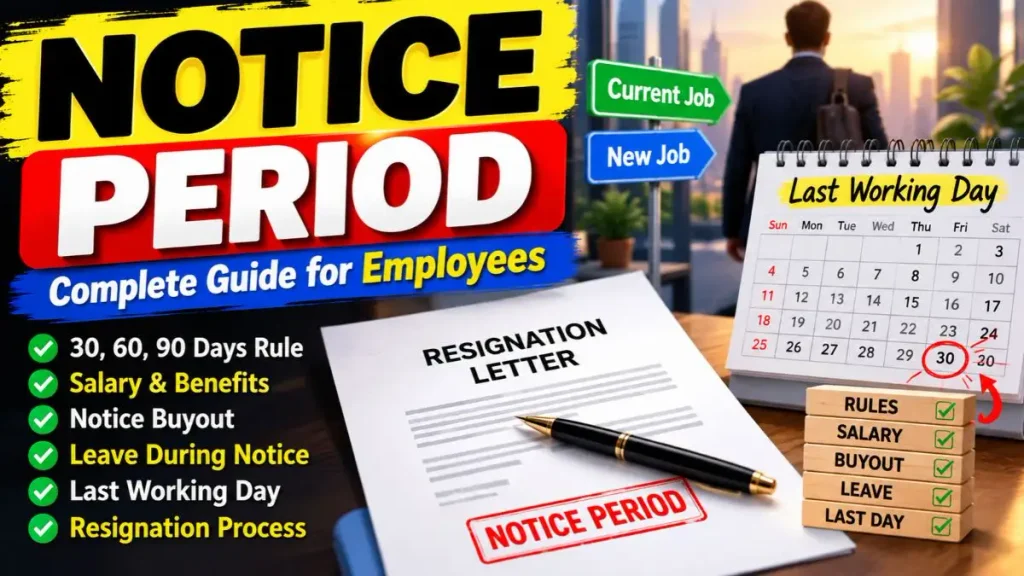
A notice period is the time between submitting your resignation and your official last working day. During this period, an employee is generally expected to continue performing their responsibilities, complete pending work and support the transition to another employee or replacement.
The exact notice period depends on the employment contract, company HR policy, job role, level of responsibility and applicable employment terms. In India, notice periods commonly range from around 30 days for some roles to 60 or 90 days for certain senior or specialised positions.
Understanding your notice period before accepting a new job can help you avoid problems with your current employer, joining-date conflicts, salary expectations and future employment verification.
What Is a Notice Period?
A notice period is the predetermined period an employee must usually serve after formally resigning from a company.
For example, suppose your employment contract specifies a 60-day notice period. If you submit your resignation on October 5, your expected last working day would generally fall around the end of the applicable 60-day period, subject to your company's method of calculating the notice period and HR approval.
The notice period gives the employer time to:
- Plan for a replacement
- Transfer responsibilities
- Complete pending projects
- Arrange knowledge transfer
- Reallocate workloads
- Complete HR and payroll procedures
- Prepare the employee's exit documentation
For employees, it provides time to complete their professional commitments and make a smoother transition to their next career opportunity.
Why Is a Notice Period Important?
A notice period is important because an employee's departure can affect projects, customers, teams and business operations.
Leaving professionally can also protect your long-term career interests. Former employers may be contacted for employment verification, references or other professional information during future hiring processes.
A well-managed resignation can therefore help maintain a positive professional relationship with your employer and colleagues.
It is also important to remember that the notice period is usually connected to the terms agreed upon when you joined the organisation. Employees should review their appointment letter, employment agreement, HR policy and other relevant documents before resigning.
How Long Is the Notice Period in India?
There is no single notice period that applies to every private-sector employee in India.
The applicable period can vary depending on:
- Employment contract
- Company policy
- Job position
- Seniority
- Industry
- Employment type
- Probationary status
- Nature of responsibilities
- Applicable employment regulations
For example, some organisations may have a 30-day notice period, while others may require 60 or 90 days, particularly for senior, managerial or specialised positions.
This is why candidates should never assume that every company follows the same notice period.
Always check your employment documents before making a resignation decision.
Notice Period During Probation
Employees who are still on probation may have a different notice period from permanent employees.
For example, a company may specify a shorter notice requirement during probation. However, the actual terms depend on the appointment letter and company HR policy.
Before resigning during probation, check:
- Your offer letter
- Appointment letter
- Probation terms
- HR policy
- Notice period clause
Do not rely solely on what another employee tells you because notice requirements can differ between organisations and employment contracts.
What Is a 30-Day Notice Period?
A 30-day notice period means that the employee is generally expected to remain employed for approximately 30 days after submitting resignation, subject to the terms of the employment contract and the company's resignation process.
A 30-day notice period is relatively common in many professional roles.
During these 30 days, employees should focus on completing important responsibilities, documenting ongoing work and ensuring a proper handover.
What Is a 60-Day Notice Period?
A 60-day notice period requires an employee to continue working for approximately two months after resignation, depending on the applicable contractual terms.
Longer notice periods can sometimes make job switching more challenging because a new employer may want the candidate to join earlier.
If you are currently serving a 60-day notice period, clearly communicate your expected last working day to recruiters and potential employers.
This helps the hiring team determine whether your availability matches the company's hiring timeline.
What Is a 90-Day Notice Period?
A 90-day notice period is commonly associated with certain senior, managerial, specialised or highly responsible positions.
For job seekers, a three-month notice period can create challenges when applying for jobs that require immediate joining.
However, a long notice period does not automatically mean that you cannot change jobs. Depending on company policy and the employment contract, an employee may be able to discuss options such as:
- Notice period reduction
- Early release
- Leave adjustment
- Notice period buyout
- Negotiated joining date
Any such arrangement should be confirmed with the current employer rather than assumed.
Can You Leave Without Serving the Notice Period?
Leaving without serving the required notice period can have financial, contractual or professional consequences depending on the terms of your employment.
Some employment contracts include provisions regarding notice period buyout, salary in lieu of notice or early release.
Therefore, employees should not simply stop attending work after submitting a resignation.
Instead, discuss the situation with your manager or HR department and obtain written confirmation of any agreed early-release arrangement.
What Is Notice Period Buyout?
A notice period buyout generally refers to an arrangement where the employee does not serve some or all of the required notice period and instead pays an amount according to the applicable contractual terms.
For example, if an employee has a 60-day notice period but wants to leave earlier, the employment contract may provide a mechanism for paying the equivalent amount for the unserved period.
However, the exact calculation and whether a buyout is permitted depend on the employment contract and company policy.
Employees should always confirm:
- Whether notice buyout is allowed
- Who can approve it
- How the amount is calculated
- Whether the new employer can reimburse the amount
- Whether written approval is required
- How the final settlement will be handled
Never assume that paying money automatically gives an employee the right to leave immediately.
What Is Salary in Lieu of Notice?
Salary in lieu of notice generally refers to compensation paid instead of working through the applicable notice period, where the employment terms permit such an arrangement.
The calculation method can vary depending on the contract and employer policy.
Because salary, allowances, benefits and other compensation components may be treated differently, employees should check the exact wording of their employment agreement and confirm the calculation with HR.
Can You Use Paid Leave During the Notice Period?
Whether an employee can use accumulated or earned leave during the notice period depends on the company's leave policy and applicable employment terms.
Some companies may allow certain types of leave, while others may restrict leave during the notice period because the employee is required to complete a proper handover.
Therefore, do not automatically deduct your remaining leave from the notice period.
Ask HR for written confirmation of how your unused leave will be treated during your final settlement.
What Happens to Your Salary During the Notice Period?
In a normal resignation process, employees generally continue receiving their applicable salary while they remain employed and work through the notice period.
However, salary processing, deductions, incentives, reimbursements and other components of compensation can depend on company policy and the employment agreement.
Employees should also keep track of:
- Final salary
- Pending reimbursements
- Incentives or bonuses
- Leave encashment, where applicable
- Tax deductions
- Employee benefits
- Provident fund-related processes
- Final settlement
Understanding these components can help you plan your personal finances before moving to your next job.
How to Calculate Your Last Working Day
Your last working day usually depends on:
Date of resignation + applicable notice period = expected last working date
However, companies may have specific rules for calculating the period, including whether the resignation date itself is counted.
For this reason, the safest approach is to ask HR to confirm the official Last Working Day (LWD) in writing.
This is particularly important when you already have another job offer because your new employer may ask for your confirmed joining date.
What Should You Do Before Resigning?
Before submitting your resignation, take a few important steps.
1. Review Your Employment Contract
Read the notice period clause carefully.
Check whether it specifies:
- Notice duration
- Buyout provisions
- Early-release conditions
- Leave rules
- Termination conditions
- Final settlement process
Your employment contract is one of the most important documents to review before making the decision.
2. Secure Your Next Job
If you are resigning because you have received another employment opportunity, ideally confirm the important details before resigning.
Review the:
- Job offer
- Designation
- Compensation
- Joining date
- Location
- Work arrangement
- Benefits
- Probation terms
- Employment conditions
Do not rely only on a verbal promise from a recruiter.
3. Confirm Your Joining Date
If you have a long notice period, tell the new employer your realistic availability.
For example:
"My current contractual notice period is 60 days, and my expected last working day is December 5."
Being transparent about your availability can prevent problems after accepting a job offer.
4. Prepare Your Resignation Letter
Your resignation letter should be short, professional and clear.
Mention your intention to resign and your expected last working day according to your applicable notice period.
5. Prepare a Proper Handover
Create documentation for ongoing projects, important contacts, recurring tasks, passwords or access procedures that can legally and appropriately be transferred, and other work-related information.
A professional handover makes the transition easier for both you and your employer.
How to Serve Your Notice Period Professionally
The notice period is still part of your employment. Your performance and behaviour during this period matter.
Follow these practices:
Continue Working Professionally
Do not assume that your responsibilities no longer matter because you have resigned.
Continue completing your assigned work and meet reasonable deadlines.
Complete Knowledge Transfer
Document important processes and explain ongoing responsibilities to the person taking over your work.
Maintain Professional Communication
Avoid unnecessary arguments or negative discussions about your employer.
Even when you are leaving because of dissatisfaction, maintain a professional tone.
Keep Important Documents
Before your last working day, make sure you understand the process for receiving relevant employment documents such as:
- Experience letter
- Relieving letter
- Salary slips
- Tax documents
- Final settlement statement
- Other applicable employment records
The exact documents provided can vary by employer.
Confirm Your Last Working Day
Always keep written confirmation of your final working date.
This can be especially important when coordinating your joining date with another employer.
What If Your New Employer Wants You to Join Immediately?
This is a common situation for job seekers.
Suppose your current employer requires a 90-day notice period, but your new employer wants you to join within 30 days.
Do not hide your notice period from the new employer.
Instead, discuss possible options such as:
- Negotiating an earlier release
- Discussing notice buyout where permitted
- Requesting a shorter notice period
- Negotiating a later joining date
- Exploring whether the new employer supports notice buyout
Some employers may be willing to work with candidates who have longer notice periods, particularly when the candidate has specialised skills or relevant experience.
Can a New Employer Buy Out Your Notice Period?
In some situations, a new employer may agree to reimburse or support the cost associated with a notice period buyout.
However, this is not universal.
The arrangement should be clearly documented between the relevant parties, including:
- Amount
- Payment responsibility
- Reimbursement terms
- Joining conditions
- Documentation requirements
Never assume that a recruiter saying "we can buy out your notice" means the arrangement is automatically approved.
Ask for the terms in writing.
What Is Garden Leave?
Garden leave is different from a normal notice period and notice buyout.
Under a garden leave arrangement, an employee may remain employed and continue receiving applicable compensation while being instructed not to perform normal work duties for a specified period.
This can be used in situations where the employer wants to protect confidential information, customer relationships or business interests during an employee's transition.
The exact rights and restrictions depend on the employment agreement and applicable terms.
Notice Period and Job Search
A long notice period can affect your job search strategy.
If you are actively looking for a new job, mention your availability clearly on your resume or during recruiter conversations.
For example:
Availability: 30 Days Notice Period
or
Currently Serving Notice – Available From 15 December 2026
This gives recruiters useful information before they move forward with the hiring process.
However, avoid making your notice period the only focus of your job search. Your skills, experience, qualifications, salary expectations and suitability for the role remain important factors.
Common Mistakes to Avoid During Notice Period
1. Resigning Without Reading Your Contract
Never assume your notice period is 30 days simply because someone else in your industry has a 30-day notice.
2. Hiding Your Notice Period
Be honest with recruiters about your actual availability.
3. Stopping Work After Resignation
Submitting a resignation does not normally mean you can stop performing your duties immediately.
4. Making Unprofessional Statements
Your professional reputation can continue to matter after you leave.
5. Ignoring the Handover
Leaving incomplete documentation can create unnecessary problems.
6. Accepting a Joining Date You Cannot Meet
Always calculate your realistic last working day before committing to a joining date.
7. Relying on Verbal Approval
If HR approves early release or another arrangement, ask for written confirmation.
Notice Period Checklist for Employees
Before leaving your current job, use this checklist:
Before Resignation
☐ Review employment contract
☐ Check notice period
☐ Confirm your next job offer
☐ Verify compensation and benefits
☐ Confirm proposed joining date
☐ Understand notice buyout terms
During Notice Period
☐ Complete pending responsibilities
☐ Prepare knowledge-transfer documents
☐ Cooperate with your replacement
☐ Maintain professional behaviour
☐ Return company property
☐ Complete required HR formalities
Before Your Last Working Day
☐ Confirm official last working day
☐ Check final salary process
☐ Understand final settlement
☐ Collect relevant employment documents
☐ Confirm benefits and pending reimbursements
☐ Keep personal copies of legally permissible employment records
Frequently Asked Questions About Notice Period
Q1. Is notice period mandatory in India?
The applicable requirement depends on the employee's employment terms, company policy and relevant legal provisions. The employment contract should be the first document you check to understand your contractual notice requirement.
Q2. Can I negotiate my notice period?
In some situations, employees can request an early release or negotiate the notice period with their employer. Approval depends on the organisation and applicable employment terms.
Q3. Can I join another company while serving notice period?
Generally, you remain employed by your current organisation until your employment officially ends. Any arrangement involving outside employment should be reviewed carefully against your employment contract and company policies.
Q4. What happens if I do not serve my notice period?
The consequences depend on your employment contract and company policy. They may involve financial recovery, documentation issues or other contractual consequences. Discuss the situation with HR before taking action.
Q5. Does notice period affect job offers?
It can. Some employers prefer candidates who can join quickly, while others are willing to wait for candidates with longer notice periods, particularly for specialised roles.
Q6. What is the difference between notice period and probation period?
A notice period is the time associated with ending an employment relationship after resignation or termination. A probation period is an initial evaluation period when an employee joins a new organisation. They serve different purposes.
Final Thoughts
A notice period is an important part of the job transition process. Whether you have a 30-day, 60-day or 90-day notice period, understanding your employment contract and communicating clearly with both your current and prospective employer can make the transition significantly easier.
Before submitting your resignation, review your contractual terms, confirm your next career move and understand the financial and HR implications of leaving your current organisation.
Most importantly, treat your notice period as part of your professional journey—not simply as the final few weeks of a job. A responsible handover, professional communication and proper documentation can help you leave on good terms and protect your professional reputation for future career opportunities.
Disclaimer: Employment terms, notice requirements, salary deductions, notice buyout and final settlement procedures can vary by employer, contract, role and applicable law. This article is intended for general informational purposes and should not be treated as legal or financial advice. Employees should review their employment documents and consult their HR department or a qualified professional for situation-specific guidance.